To create a safe and positive experience for your animals, it is important to keep a few basic principles in mind when you plan and draw training fences and virtual fences.
The fence boundary should work as a natural barrier for the animals. If there are places or objects in the grazing area that the animals are used to using, and these are located close to the physical fence, it is important that the animals still have access to them.
We recommend keeping the sides of the fence simple and free of anything that attracts the animals. This makes it easier for them to understand where the boundary is.
Specific recommendations
Here we start from training areas that are enclosed by physical fences. The same recommendations also apply to virtual fences without physical fences.
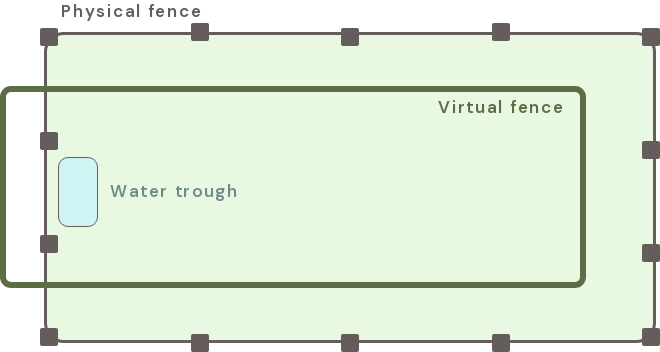
Water source
If the water source is located close to the physical fence, we recommend placing the virtual fence boundary a good distance outside both the water source and the physical fence, so that the animals still have access to water.
This makes the text more general and useful for different types of pasture.
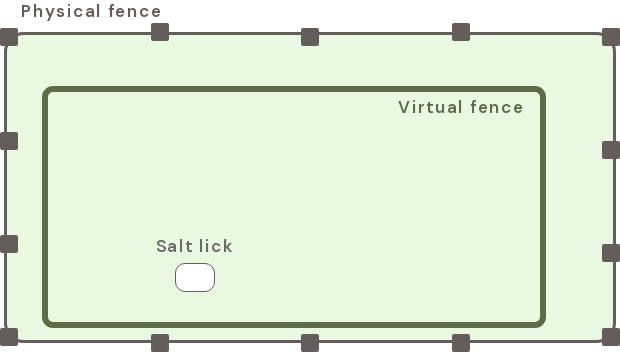
Salt lick/mineral lick
If the salt lick is placed next to the physical fence, the virtual fence boundary should be placed outside it, so that the animals still have access to it.
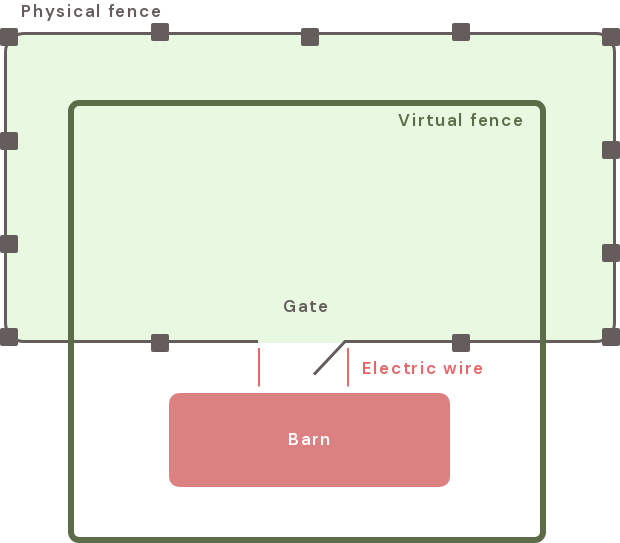
Gate or opening
Place the virtual fence boundary on the outside of the gate, at least 30 meters beyond it. This is important so that the animals do not become unsure or frightened when they later need to leave the training area.
By following these recommendations, you create good conditions for safe and effective training with the virtual fence.