
Finding a cow, moving fences, and driving between pastures all take time. Time you'd rather spend where it matters most.
Virtual fencing doesn't replace good ranching or farming. It gives you better tools to do the job. Move cattle from your phone, know where your herd is and get alerts when an animal may need attention.
This guide covers how Monil system works, what it costs, and what to know before getting started.
How does virtual fencing with collars work?
Instead of building a physical fence, you draw a boundary on the map in the Monil app. GPS-enabled collars let the system know where cattle are in relation to that boundary.
When an animal crosses the virtual fence line an audio cue will begin to play. If the animal does not correct its behavior within 7 seconds by turning back into the paddock an ePulse will be administered.
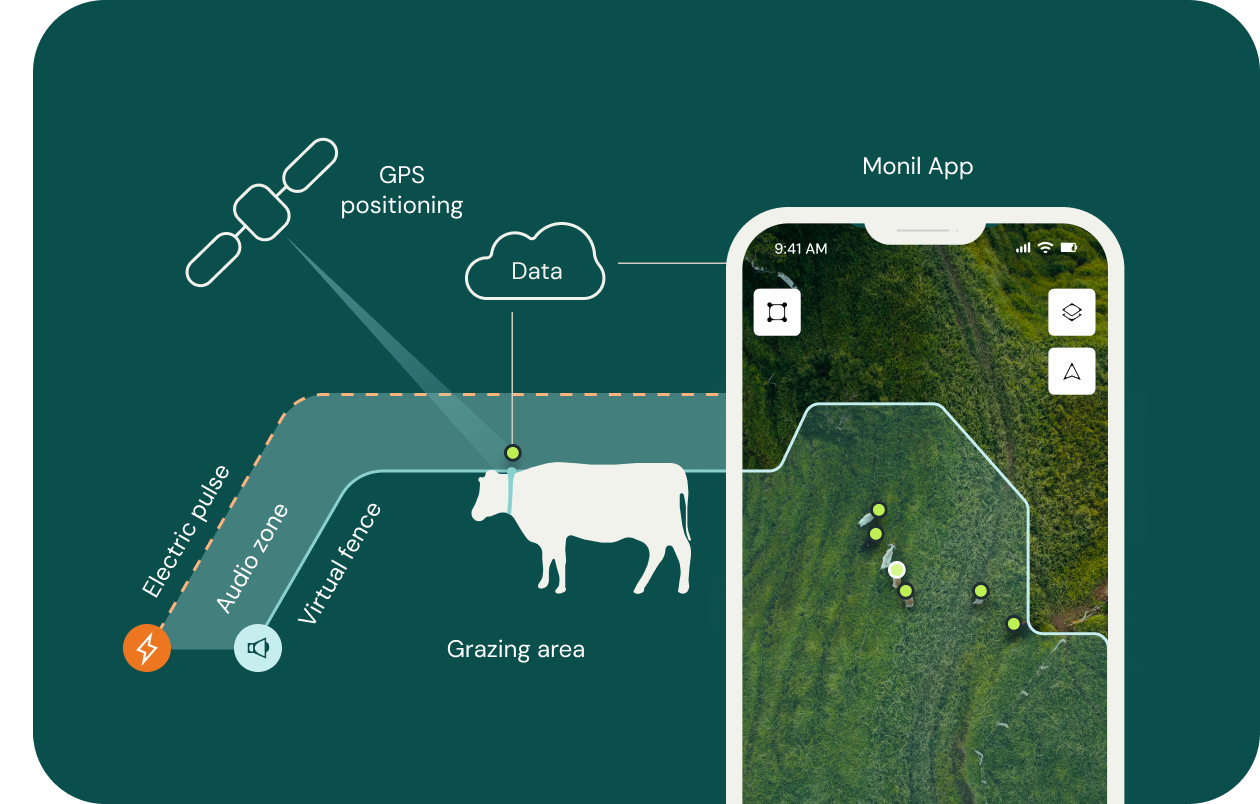
During training, cattle learn to respond to the audio cue and turn back. Once they're trained, you can adjust grazing boundaries from your phone without moving posts or wire.
Virtual fencing is a tool that gives you more flexibility to manage grazing, rather than a physical barrier to completely replace perimeter fences. That’s why proper training and maintaining fences in high-risk areas are so important.
Is virtual fencing right for your operation?
Start by thinking about what you want to accomplish on your cattle operation. Whether you're managing a small herd or hundreds of cattle, a Monil order can start at just six collars.
Where could Monil help?
- Cow-calf and seedstock operations: Keep track of valuable breeding animals, get calving alerts, and know when a cow may need attention.
- Farms short on time or labor: Spend less time moving fences, driving between pastures, and looking for cattle.
- Ranches with rough or remote terrain: Set grazing boundaries where building and maintaining physical fences is difficult or expensive.
- Stocker and finishing operations: Make grazing moves easier, maximize forage utilization, and adjust grazing areas to support changing nutritional requirements throughout the growing and finishing phases.
- Regenerative and mixed-species operations: Make frequent grazing moves easier, manage pasture recovery, and plan grazing for cattle and sheep. Monil sheep collars are expected to be available for delivery in spring 2027.
When Monil might not be the right fit? Monil requires at least one bar of AT&T or T-Mobile cellular coverage to operate. Limited coverage in your area? Stay tuned! Satellite connectivity is coming in 2027, bringing Monil to even more remote locations.
Will virtual fencing pay off for you?
Every operation is different. The value of virtual fencing depends on what you're spending today and what you could do differently tomorrow.
Start with what you're already spending:
- Fencing: Posts, wire, gates, repairs, and new fence construction.
- Time: Hours spent moving fences, checking cattle, and managing grazing.
- Travel: Fuel, vehicle wear, and trips between pastures.
Now think about what you could gain:
- Save time and money by cutting back on fencing, driving and daily chores.
- Get more from your land with more flexible grazing and better use of available forage.
- Protect what you've worked hard to build by knowing where your cattle are and getting alerts when they may need attention.
Not every benefit shows up on a balance sheet. Sometimes it's peace of mind knowing your cattle are where they should be, even when you're not there.
What makes virtual fencing systems different?
Not all virtual fencing systems work the same way. Before choosing one, it's worth understanding a few differences that can affect how well it works on your operation.
Some virtual fencing systems need towers or base stations installed on your land. Others connect through cellular networks.
Monil collars connect directly to AT&T and T-Mobile networks, so there's no need to install or maintain towers or base stations.
Collars spend a lot of time out in the elements, so their design and power source matter.
Monil's solar-powered electronics sit on top of the neck, where they get better sun exposure and are protected from some of the wear that comes with everyday cattle movement. The collars are designed to stay on cattle throughout the grazing season without frequent charging.
Knowing where your cattle are is useful. Knowing when one might need attention can be just as important.
Along with live locations, Monil provides calving, stuck, and low-activity alerts. These can help you spot potential problems sooner and decide when it's worth going out to check an animal.
Some systems lease collars, while others let you buy them. It's worth understanding what you're paying for and what happens if your herd size changes.
With Monil, you own your collars from day one. You can add more as your herd grows, or sell and transfer collars if your needs change.
Your cattle's locations and activity tell a story about your operation. It's worth asking any provider how that information is used and who it may be shared with.
Monil uses your herd data to provide and support the service. We don't sell your data or routinely share herd locations or counts with government agencies, except where disclosure is required by law.
Technology is only useful if you can count on it when you need it.
Monil's US team can help with setup, cattle training, and troubleshooting. Replacement collars can be shipped from our US inventory, and cattle collars come with a 10-year warranty.
Graze your herd exactly the way you want to with our app!
Here's what farmers can do with fences in the app today:
- Draw a pasture on the map in any shape, then change it from the phone later. The collars pick up the new boundary over the mobile network.
- Add up to 32 exclusion zones inside a pasture, like buildings or ponds. The outer boundary and the no-go zones together can have up to 256 corner points, plenty to work with!
- Edit the outer boundary and the no-go zones in the same view, with undo and redo.
- See the pasture's acreage update as you draw a fence.
- Copy a pasture to use as the starting point for the next paddock, or share a copy with a neighboring farm when you graze common land together.
- Move a herd or group to a new pasture and watch the animals on the map, marked "in transit", while they move from one fence to the next.
- Get guidance while drawing: the app points out shapes the collars can't follow, like corners that are too sharp, too many points or a pasture that's too big, and asks you to fix them before saving.
Losing cellular connectivity doesn't mean farmers lose all control of their Monil collars.
- Existing fences stay active. During an outage, collars continue using the last downloaded virtual fence, so cattle remain within their existing boundaries.
- Bluetooth provides a local option. A farmer near the herd can use Bluetooth in the Monil app to pause the fence on each collar, then move cattle using traditional methods.
- New fence updates require connectivity. Without a connection, farmers cannot send a new or modified virtual fence to the collars.
Real Life Example: If cattle are in a 2-acre paddock and connectivity goes down, the farmer can go to the herd, pause each collar using Bluetooth, and move the cattle to the next pasture manually.
All Monil collars sold in the U.S. are satellite-ready, with satellite connectivity planned for 2027 to support areas with limited cellular coverage. For now, Monil collars require sufficient AT&T or T-Mobile coverage to operate.
How to test your pastures:
You can use our T-Mobile coverage test guide or simply take a phone connected to AT&T or T-Mobile (yours or a friend's) and drive through your pastures.
Look for at least one bar of service throughout your grazing areas to help ensure your collars will stay connected.
What does Monil cost?
With Monil, you buy your collars and pay an annual subscription.
- Collars: $280 each. You own them.
- Annual subscription: From $40 per assigned collar, depending on your order size. Volume discounts available for collar orders 50 and above.
- Minimum first order: 6 collars.
The subscription covers cellular connectivity, app updates, new features and customer support.
What would it cost for 20 cattle?
Cost Estimate:
20 collars × $280 = $5,600
Annual subscriptions × $40 = $800
Shipping = $260
Total first-year cost with subscription before tax $6,660.00
After the first year, you'd pay $800 per year for 20 active collars subscriptions ($40 a head annually). Shipping from Norway is currently $100 per order plus $8 per collar. All import fees are handled by Monil.
How many collars do you need?
Plan on one collar for each animal per herd.
Collars are not intended for calves less than 6 months old. Bulls may need an extender, depending on neck size.
You do not generally need spare collars, although it could be smart to have a few extra bands on hand in case you need to replace one. If a part needs replacing, Monil can ship bands or locks from its US inventory.
Check these things before your order
- Cellular coverage: Monil collars use AT&T and T-Mobile networks currently, but your personal cell phone can use any carrier. You need at least one bar of AT&T or T-Mobile coverage in the areas where cattle will graze. Existing virtual fences continue working through temporary dead spots, but new boundaries and current data require a connection.
- Physical perimeter and high-risk fencing: Virtual fencing doesn't replace every physical fence. Keep physical fencing around roads, property boundaries and other high-risk areas.
- Water: Virtual fence makes paddock design much more flexible, but it does not solve water access. Think through how cattle will reach water as you change grazing areas.
- Handling facilities: You will need a safe way to gather and handle cattle when fitting collars.
From ordering to creating your first fence
Monil keeps setup simple.
1. Get your collars. We'll help you work out how many you need and get your order ready.
2. Fit, train, and start grazing. Fit the collars, teach cattle to respond to the audio warning in a safely fenced area, and then begin managing grazing boundaries from the app. Training takes roughly 7 days.
A quick start guide training guide is provided after purchase and is also available through Monil’s online support resources. And if you would rather talk it through with someone, we’re here for that too. You can call our support line (614) 639-3122.
After getting Monil collars, make sure to join our Monil US User group to see how other cattlemen and women are using their collars.
What about maintenance and warranty?
Monil collars are built with efficiency in mind. Software updates happen automatically, so you don't need to remove collars from your cattle to update them.
The band and lock are the main replaceable parts. The band is designed to break if an animal gets caught, helping protect the collar's electronics. Replacement bands are stocked in the US and currently cost $36.
Every Monil cattle collar comes with a 10-year warranty, which covers manufacture defects. This excludes wear and tear, loss and other damage.
What support can you expect after you become a customer?
When you need help, you want to talk to someone who understands your operation, not just the technology.
That's why Monil has a US-based Farmer Success team with people who come from the livestock industry. They'll help you get started, train your cattle and make the most of Monil as your operation evolves.
And the relationship doesn't end once your collars are fitted. They keep an eye on system performance and may reach out if something needs checking, or simply to see how things are going.
Support is included in your annual subscription. Whether you have a question about the app, need help with a collar, or want to talk through your grazing setup, there's someone you can reach out to.
Your Monil buying checklist
You don’t need to have everything figured out before talking with us. But thinking through a few questions can help the team understand your operation and whether virtual fencing is a good fit.
- How much can virtual fencing change my operation?
- How much time and money am I spending today on fencing, travel, and cattle moves?
- Where could more flexible grazing create additional value?
- Do I have at least one bar of coverage from AT&T or T-Mobile coverage in the pastures I am looking to graze?
- How will cattle access water as grazing areas change?
- How many cattle need collars?
- Do I want to collar the whole herd, or Do I have a smaller herd that runs together I want to try it on first?
- Am I ready to change the way I manage grazing enough to get value from the system?
Not sure about some of the answers? That’s okay. Our team can talk through it, help you understand what you need, and evaluate whether Monil is a good fit for your farm.
Interested in learning more about Monil for your operation? Fill in the form below and our team will get in contact.